Net-zero emissions energy systems
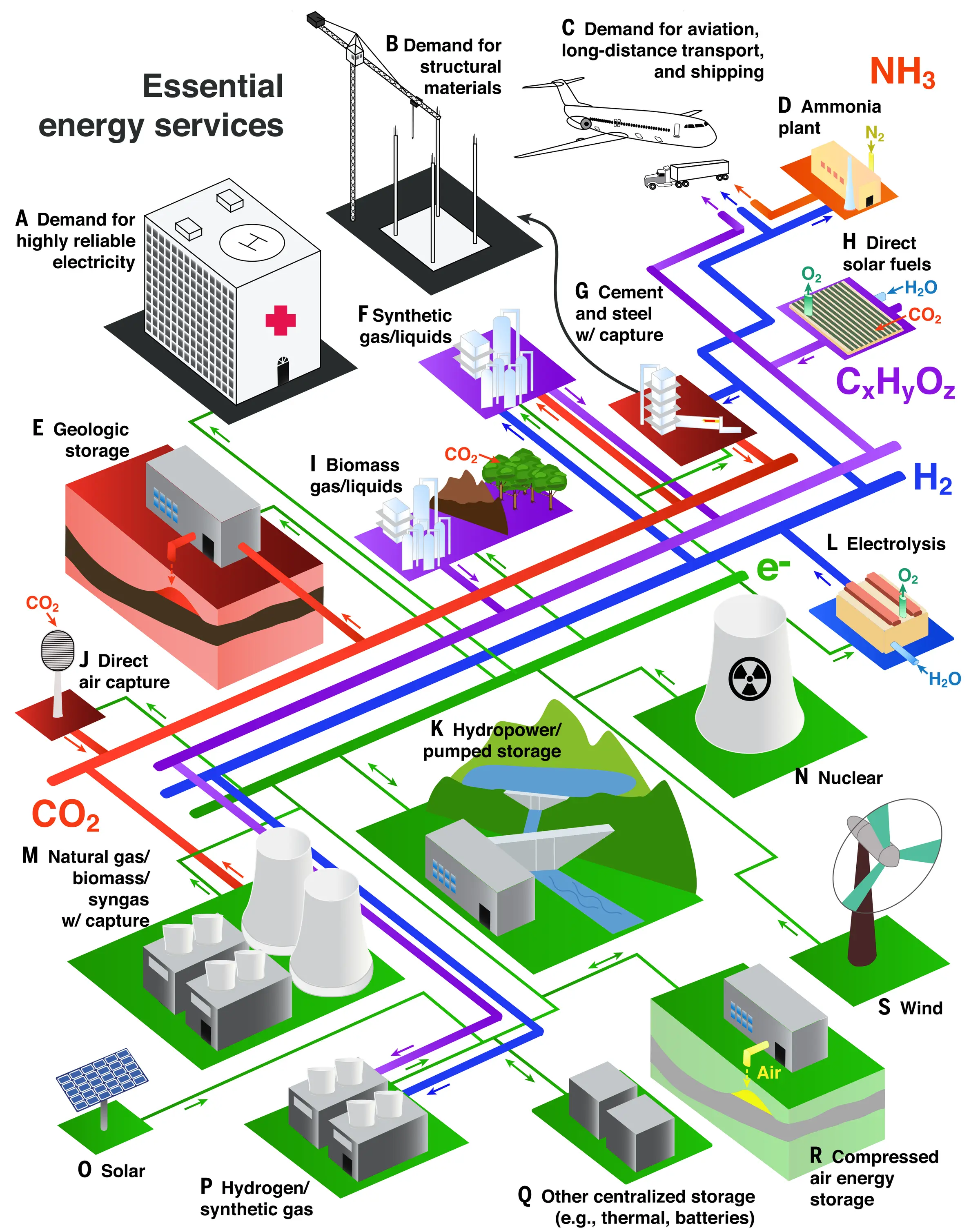
Key finding. Some parts of the energy system are particularly difficult to decarbonize — aviation, long-distance transport, steel and cement production, and the provision of reliable electricity — and addressing them requires integrating energy sectors and industrial processes that are currently discrete, rather than decarbonizing each in isolation.
What question did this research address?
Models agree that global CO2 emissions must reach zero later this century, and most of those emissions come from energy use. That leaves the question of what reaching zero would actually involve, service by service.
This review asked which parts of the energy system are straightforward to decarbonize and which are not, and what technologies and system designs could address the difficult remainder.
What did we find?
The difficulty is not uniform. Much of the energy system has reasonably clear decarbonization pathways; the review isolates the subset that does not.
Aviation and long-distance transport are hard because they need energy carriers with high energy density that batteries do not presently provide.
Steel and cement are hard because their emissions are partly intrinsic to the chemistry of the process rather than to the energy used to drive it, so clean electricity alone does not remove them.
Reliable electricity is hard for reasons of timing rather than quantity — matching a variable supply to demand at every hour is a different problem from generating enough energy in total.
Current technologies and pathways show promise for each, but integration across now-separate sectors and processes is what the review identifies as vital to achieving minimal emissions.
Why does it matter?
Naming the hard parts is what makes the remaining problem tractable. Decarbonization discussions often generalize from the sectors where progress is easiest, which understates what is left.
The emphasis on integration cuts against how energy policy is usually organized. If the residual emissions are concentrated where sectors meet — fuels for industry, storage for electricity, feedstocks for materials — then sector-by-sector policy is poorly matched to where the difficulty actually lies.
Citation
Steven J. Davis, Nathan S. Lewis, Matthew Shaner, Sonia Aggarwal, Doug Arent, Inês L. Azevedo, Sally M. Benson, Thomas Bradley, Jack Brouwer, Yet-Ming Chiang, Christopher T. M. Clack, Armond Cohen, Stephen Doig, Jae Edmonds, Paul Fennell, Christopher B. Field, Bryan Hannegan, Bri-Mathias Hodge, Martin I. Hoffert, Eric Ingersoll, Paulina Jaramillo, Klaus S. Lackner, Katharine J. Mach, Michael Mastrandrea, Joan Ogden, Per F. Peterson, Daniel L. Sanchez, Daniel Sperling, Joseph Stagner, Jessika E. Trancik, Chi-Jen Yang, and Ken Caldeira (2018). Net-zero emissions energy systems. Science 360.