What We Publish
What We Publish
What questions did we address? What did we find? And why does it matter?
Reliability of wind and solar power · Climate and the carbon cycle · Climate and energy · Climate and economics · Solar geoengineering · Ocean acidification and the ocean carbon cycle · Geophysics of wind power · Paleoclimate and Earth-system dynamics in geologic time · Macro-energy modeling
Selected publications
-

Cost-effective approaches to maintaining resource adequacy in wind and solar electricity systems over decades of weather variability
-

From temporal variability to integrated metabolic balance: interpreting total alkalinity and dissolved inorganic carbon relationships in dynamic coral reef ecosystems
-

The effect of land costs on the economic and sustainability performance of solar photovoltaics in China
-

Supplying process heat using concentrated solar thermal energy with molten salt storage
-

Variability of technology learning rates
-

Historical model biases in monthly high temperature anomalies indicate under-estimation of future temperature extremes
-
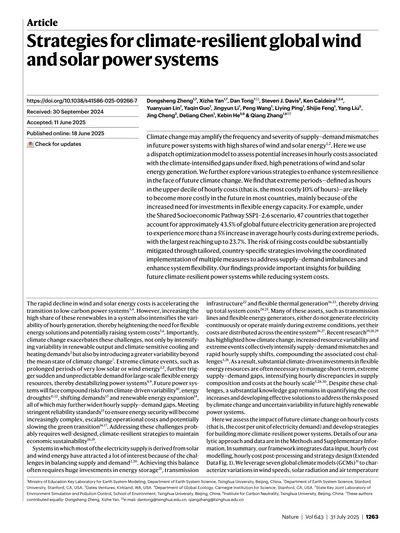
Strategies for climate-resilient global wind and solar power systems
-

Correlation and cyclicity of stratigraphic sequence boundaries and chronostratigraphic stage boundaries over the last 253 million years
-

Trade risks to energy security in net-zero emissions energy scenarios
-

Utilizing curtailed wind and solar power to scale up electrolytic hydrogen production in Europe
-

Near-term benefits from investment in climate adaptation complement long-term economic returns from emissions reduction
-

A stylized study of the climate response to longwave and shortwave forcing at the altitude of aviation-induced cirrus
-

Economic development, air conditioning and adaptation to warming
-

Oahu as a case study for island electricity systems relying on wind and solar generation
-

Opportunities and constraints of hydrogen energy storage systems
-

Planning reliable wind- and solar-based electricity systems
-

Rate of global warming projected to decline under current policy
-

Dependence of climate and carbon cycle response in net zero emission pathways on the magnitude and duration of positive and negative emission pulses
-

Identification of reliable locations for wind power generation through a global analysis of wind droughts
-

Sixteen mass extinctions of the past 541 million years correlated with 15 pulses of Large Igneous Province volcanism and 4 large impacts
-

Implications of uncertainty in technology cost projections for least-cost decarbonized electricity systems
-

The influence of regional geophysical resource variability on the value of single- and multistorage technology portfolios
-

Broad range of technologies could firm up wind and solar generation in net zero carbon dioxide emission electricity systems
-

Food without agriculture
-

Cycles of ~32.5 My and ~26.2 My in correlated episodes of continental flood basalts, hyper-thermal climate pulses, anoxic oceans, and mass extinctions over the last 260 My
-

Quantification of tropical monsoon precipitation changes in terms of interhemispheric differences in stratospheric sulfate aerosol optical depth
-

Move up or move over: mapping opportunities for climate adaptation in Pakistan's Indus plains
-

Global land and water limits to electrolytic hydrogen production using wind and solar resources
-

Comment on "Climate consequences of hydrogen emissions" by Ocko and Hamburg (2022)
-

The value of reducing the Green Premium — cost-saving innovation, emissions abatement, and climate goals
-

Contrasting climate and carbon-cycle consequences of fossil-fuel use versus deforestation disturbance
-

Stylized least-cost analysis of flexible nuclear power in deeply decarbonized electricity systems considering wind and solar resources worldwide
-

Geophysical constraints on the reliability of solar and wind power worldwide
-

Atmospheric pressure gradients and Coriolis forces provide geophysical limits to power density of large wind farms
-

Spatial constraints in large-scale expansion of wind power plants
-

A 27.5-My underlying periodicity detected in extinction episodes of non-marine tetrapods
-

Climate change as an incentive for future human migration
-
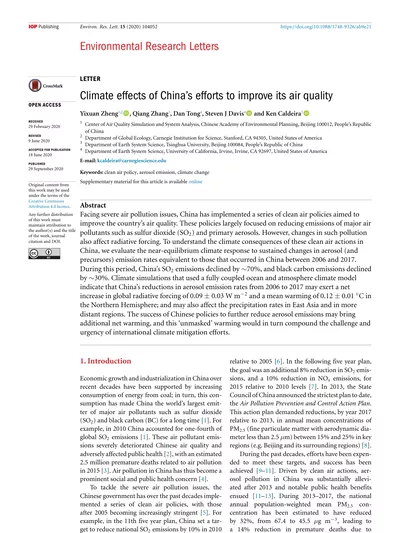
Climate effects of China's efforts to improve its air quality
-

Climate effects of aerosols reduce economic inequality
-

Break-even year — a concept for understanding intergenerational trade-offs in climate change mitigation policy
-

Role of long-duration energy storage in variable renewable electricity systems
-

Balancing climate and development goals
-

Effects of deep reductions in energy storage costs on highly reliable wind and solar electricity systems
-

Climate system response to stratospheric sulfate aerosols: sensitivity to altitude of aerosol layer
-

LongRunMIP: Motivation and Design for a Large Collection of Millennial-Length AOGCM Simulations
-

Committed emissions from existing energy infrastructure jeopardize 1.5 °C climate target
-

Induced energy-saving efficiency improvements amplify effectiveness of climate change mitigation
-

Comparison of the fast and slow climate response to three radiation management geoengineering schemes
-

Country-level social cost of carbon
-

Divergent global-scale temperature effects from identical aerosols emitted in different regions
-

Global and Arctic climate sensitivity enhanced by changes in North Pacific heat flux
-

Carbon dioxide addition to coral reef waters suppresses net community calcification
-

Net-zero emissions energy systems
-

Geophysical constraints on the reliability of solar and wind power in the United States
-

Greater future global warming inferred from Earth's recent energy budget
-

Evaluating relative benefits of different types of R&D for clean energy technologies
-

Simultaneous stabilization of global temperature and precipitation through cocktail geoengineering
-

Will the use of a carbon tax for revenue generation produce an incentive to continue carbon emissions?
-

Spatial distribution of generation of Lorenz's available potential energy in a global climate model
-

Geophysical potential for wind energy over the open oceans
-

Adapting to rates versus amounts of climate change: a case of adaptation to sea-level rise
-

Reversal of ocean acidification enhances net coral reef calcification
-

Dependence of global radiative feedbacks on evolving patterns of surface heat fluxes
-

Periodic impact cratering and extinction events over the last 260 million years
-

Fast and slow climate responses to CO2 and solar forcing — a linear multivariate regression model characterizing transient climate change
-

Combustion of available fossil fuel resources sufficient to eliminate the Antarctic Ice Sheet
-

Estimating the contribution of sea ice response to climate sensitivity in a climate model
-

Projections of the pace of warming following an abrupt increase in atmospheric carbon dioxide concentration
-

Geophysical limits to global wind power
-

The science of geoengineering
-

Risks to coral reefs from ocean carbonate chemistry changes in recent earth system model projections
-

Greenhouse gases, climate change and the transition from coal to low-carbon electricity
-

Crop yields in a geoengineered climate
-

Climate response to changes in atmospheric carbon dioxide and solar irradiance on the time scale of days to weeks
-

Climate forcing and response to idealized changes in surface latent and sensible heat
-

Albedo enhancement of marine clouds to counteract global warming: impacts on the hydrological cycle
-

Why is there a short-term increase in global precipitation in response to diminished CO2 forcing?
-

The supply chain of CO2 emissions
-

Fast versus slow response in climate change: implications for the global hydrological cycle
-

Importance of carbon dioxide physiological forcing to future climate change
-

Geoengineering as an optimization problem
-

Future CO2 emissions and climate change from existing energy infrastructure
-

Consumption-based accounting of CO2 emissions
-

The role of terrestrial plants in limiting atmospheric CO2 decline over the past 24 million years
-

Global and Arctic climate engineering - numerical model studies
-

Stabilizing climate requires near-zero emissions
-

Combined climate and carbon-cycle effects of large-scale deforestation
-

Transient climate-carbon simulations of planetary geoengineering
-

An Ancient Carbon Mystery
-

Forests, climate, and silicate rock weathering
-

Multicentury changes to the global climate and carbon cycle: results from a coupled climate and carbon cycle model
-

Ocean model predictions of chemistry changes from carbon dioxide emissions to the atmosphere and ocean
-

Major perturbation of ocean chemistry and a 'Strangelove Ocean' after the end-Permian mass extinction
-

Anthropogenic carbon and ocean pH
-

An Issue of Permanence: Assessing the Effectiveness of Temporary Carbon Storage
-

Geoengineering Earth's radiation balance to mitigate climate change from a quadrupling of CO2
-

Climate sensitivity uncertainty and the need for energy without CO2 emission
-

Carbonate deposition, climate stability, and Neoproterozoic ice ages
-

Depth, radiocarbon, and the effectiveness of direct CO2 injection as an ocean carbon sequestration strategy
-

Advanced technology paths to global climate stability — energy for a greenhouse planet
-

Accelerating carbonate dissolution to sequester carbon dioxide in the ocean: Geochemical implications
-

The role of the Southern Ocean in uptake and storage of anthropogenic carbon dioxide
-

Geoengineering Earth's radiation balance to mitigate CO2-induced climate change
-

Energy implications of future stabilization of atmospheric CO2 content
-

Predicted net efflux of radiocarbon from the ocean and increase in atmospheric radiocarbon content
-

Sensitivity of simulated CFC-11 distributions in a global ocean model to the treatment of salt rejected during sea-ice formation
-

Sensitivity of simulated salinity in a three-dimensional ocean model to upper ocean transport of salt from sea-ice formation
-

Long-term control of atmospheric carbon dioxide: low-temperature seafloor alteration or terrestrial silicate-rock weathering?
-

Insensitivity of global warming potentials to carbon dioxide emission scenarios
-

Aftermath of the end-Cretaceous mass extinction — possible biogeochemical stabilization of the carbon cycle and climate
-

Major episodes of geologic change — correlations, time structure and possible causes
-

The life span of the biosphere revisited
-

Susceptibility of the early Earth to irreversible glaciation caused by carbon dioxide clouds
-

Enhanced Cenozoic chemical weathering and the subduction of pelagic carbonate
-

The Mid-Cretaceous Super Plume, carbon dioxide, and global warming
-

Continental-pelagic carbonate partitioning and the global carbonate-silicate cycle
-

Carbon dioxide emissions from Deccan volcanism and a K/T boundary greenhouse effect
-

Evolutionary pressures on planktonic production of atmospheric sulphur