Strategies for climate-resilient global wind and solar power systems
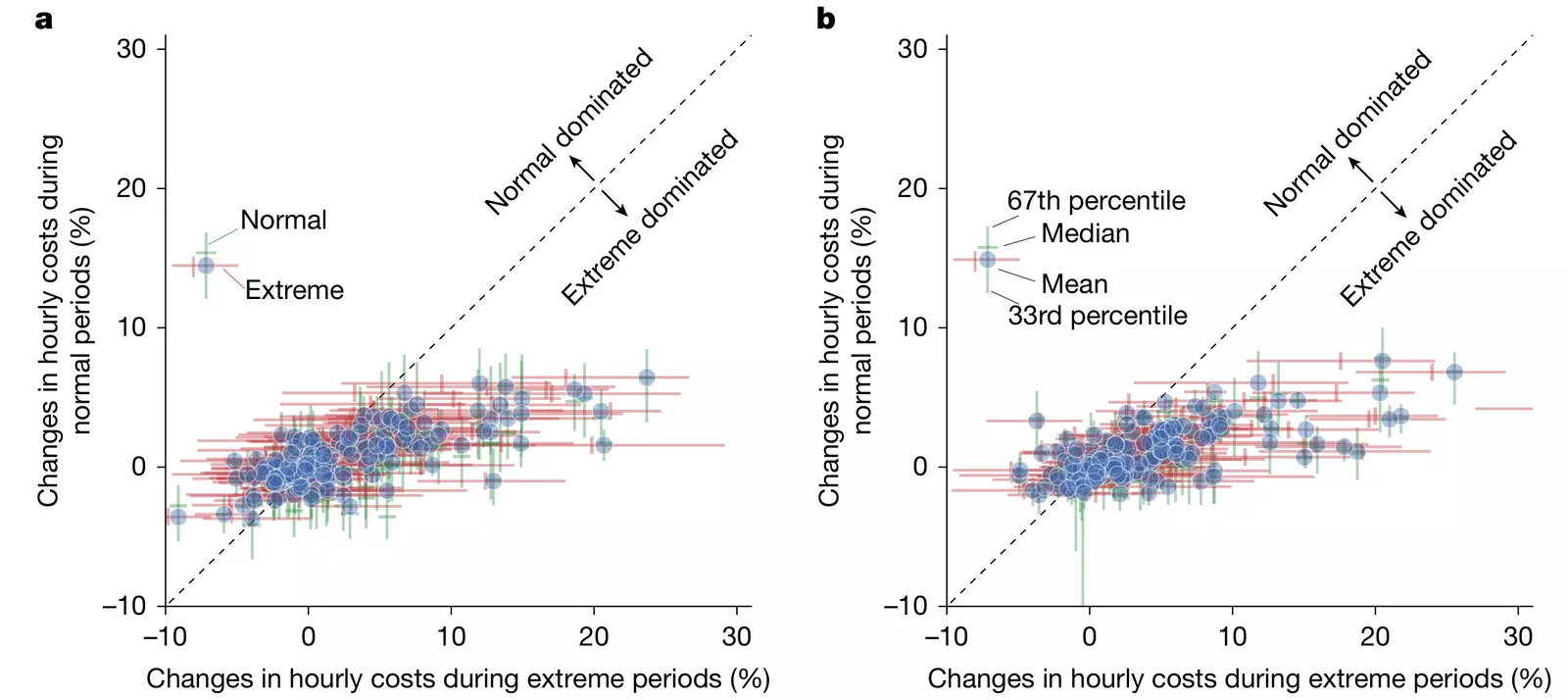
Key finding. With future wind and solar shares held fixed, climate change by 2056–2060 under the SSP1–2.6 scenario raises average electricity costs during the most expensive 10% of hours by more than 5% in 47 countries that together produce about 43.5% of the world's future electricity, and by as much as 23.7% in Tajikistan. In most countries, combining two well-chosen flexibility measures — from demand response, expanded interconnection, more efficient storage, and more flexible thermal generation — is enough to offset the climate-driven rise in average hourly costs.
What question did this research address?
Power systems that draw most of their electricity from wind and sunlight have to cover the hours when both are scarce, with storage, transmission, and backup generation that sits idle much of the year but is paid for all of it. Climate change shifts wind speeds, sunshine, and the heating and cooling demand that sets the load, and so changes how often and how badly supply and demand fall out of step.
This work asked how much that matters for cost, hour by hour, in 178 countries — holding each country's future wind and solar share fixed, so that only the climate changes — and which combinations of flexibility measures would keep the costliest hours affordable.
What did we find?
The climate changes that drive this are modest on average. Across seven climate models, mean wind speeds change by only a few hundredths of a metre per second by mid-century, while solar radiation rises by 3.1 watts per square metre under SSP1–2.6. But most large countries see longer stretches of simultaneously low wind and solar output, and demand becomes more variable, especially at high and middle latitudes such as Canada and Kazakhstan.
The cost increase falls mostly on the costliest hours. Under SSP1–2.6, 101 of the 178 countries see average costs rise during the most expensive 10% of hours. In Tajikistan the rise is 23.7% in those hours against 6.4% in the rest. The costliest tenth of hours already accounts for more than 20% of annual power-system costs in most European countries.
Large countries carry large absolute costs even when the percentage is modest. Additional climate-related costs average 15.7 billion dollars a year in the United States and 10.1 billion in India.
What drives the increase depends on what each system relies on when wind and solar fall short. Storage explains nearly all of China's 5.1% increase in its costliest hours; in France, hydropower, at only 4.2% of generation but highly flexible, drives almost all of it, because nuclear power cannot ramp quickly.
Combining measures generally beats any single one, but the right combination is national. In China no single measure cuts costliest-hour costs by more than 8.2%, while three together cut them by at least 13.0%. In France, adding expanded interconnection lifts the reduction from at most 12.7% to at least 21.8%. In Russia, with abundant hydropower, adding more flexible thermal generation to the other three measures reduces the benefit, from 16.8% to 14.9%.
The worst cases are harder to cover. For the 5% of simulations with the largest cost increases, most countries still have better than an 80% chance of offsetting them, but India, even with all four measures, has only a 61.1% chance.
Why does it matter?
Planning for a wind- and solar-heavy power system is usually done against today's weather. These results put a number on how much the climate those systems will operate in could add to the hours that already cost the most — and show that the increase is manageable with flexibility investment chosen for each country's system.
The comparison between countries is the practical lesson. Small European countries gain most from cross-border interconnection; storage efficiency matters most in solar-dominated systems such as Egypt; flexible thermal generation helps where thermal power is large, as in South Korea, but not where hydropower already supplies the flexibility.
The authors flag one risk that interconnection alone cannot solve. Climate change may make low wind and solar output coincide across neighbouring countries, so grids need to link regions with genuinely different weather, not only more of them.
The study holds wind and solar shares fixed by design and leaves out infrastructure damage from hurricanes, droughts, and wildfires, all of which would add to costs in the hours that are already the most expensive.
Citation
Dongsheng Zheng, Xizhe Yan, Dan Tong, Steven J. Davis, Ken Caldeira, Yuanyuan Lin, Yaqin Guo, Jingyun Li, Peng Wang, Liying Ping, Shijie Feng, Yang Liu, Jing Cheng, Deliang Chen, Kebin He, and Qiang Zhang (2025). Strategies for climate-resilient global wind and solar power systems. Nature 643, 1263-1270.
Related
- Can wind and solar power reliably meet electricity demand?
- Geophysical constraints on the reliability of solar and wind power worldwide (Tong et al., 2021)
- Identification of reliable locations for wind power generation through a global analysis of wind droughts (Antonini et al., 2024)
- Trade risks to energy security in net-zero emissions energy scenarios (Cheng et al., 2025)