Climate effects of China's efforts to improve its air quality
Key finding. In a fully coupled climate model, sustaining the cuts China made to its aerosol emissions between 2006 and 2017 — about 70% of its sulfur dioxide and 30% of its black carbon — adds 0.09 ± 0.03 watts per square metre of global radiative forcing and warms the Northern Hemisphere by 0.12 ± 0.01 °C at near-equilibrium.
What question did this research address?
From 2006 to 2017, China's clean air policies cut its sulfur dioxide emissions by about 70 per cent, its black carbon emissions by about 30 per cent, and its organic carbon emissions by about 40 per cent — reductions comparable to those achieved by air quality regulation in Europe and the United States over several decades. The public health gains have been extensively studied.
The same aerosols that damage health also cool the climate, mostly by reflecting sunlight and brightening clouds, and so mask part of the warming from greenhouse gases. This work asked what China's emission cuts do to the climate, locally and globally, if they are sustained, and what removing China's remaining anthropogenic aerosol emissions would add.
What did we find?
The forcing is small globally but concentrated regionally. Over East Asia the net effective radiative forcing is 0.48 ± 0.11 watts per square metre, and globally it is dominated by the shortwave cloud effect, at 0.21 ± 0.03 watts per square metre — cleaner air makes clouds less reflective.
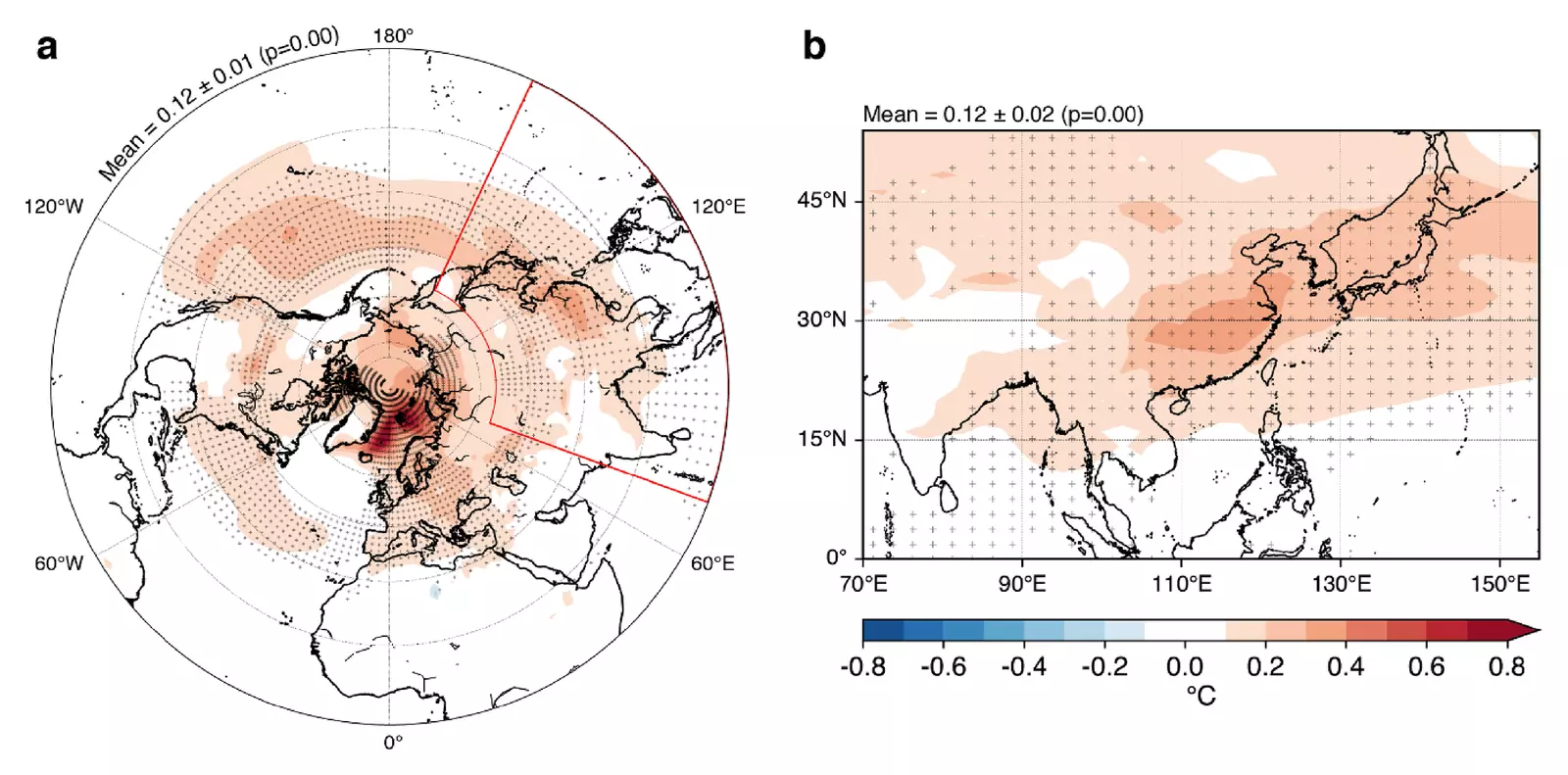
The warming spreads far beyond China. Global mean surface temperature rises 0.06 ± 0.01 °C and the Northern Hemisphere mean 0.12 ± 0.01 °C, with amplification toward the Arctic and smaller effects in the Southern Hemisphere. Mean warming over East Asia, 0.12 ± 0.02 °C, is no larger than over the hemisphere as a whole, and winter warms more than summer.
Precipitation increases. Global mean precipitation rises 2.34 ± 0.55 millimetres per year, driven mainly by the unmasked greenhouse warming, and East Asian precipitation 21.07 ± 7.60 millimetres per year, with significant increases over central and eastern China. The authors caution that the local precipitation result rests on how a single model represents aerosol–cloud interactions.
Removing all of China's remaining anthropogenic aerosol emissions after 2017 would add a further 0.14 ± 0.03 watts per square metre of global forcing, 0.09 ± 0.01 °C of global warming, and another 0.12 ± 0.01 °C in the Northern Hemisphere.
Over the same period China's CO2 emissions rose by about 54 per cent. The aerosol cuts came from end-of-pipe controls such as sulfur scrubbers, which do nothing for carbon emissions, so the two moved in opposite directions.
Why does it matter?
Air pollution control is a health necessity, and in China it is far from finished — in 2017, 64 per cent of prefecture-level cities still failed the national PM2.5 standard — so further aerosol cuts, and the warming they unmask, are to be expected.
The result shows how pollution policy can trade off against climate policy. Measures that remove aerosols without touching CO2 make the climate problem harder. Measures that cut both together — such as replacing coal with renewable energy — capture the health benefit without the added warming.
The estimates come from one climate model with all other emissions held fixed, and the authors present them as the likely scale of the effect rather than a precise prediction.
Citation
Yixuan Zheng, Qiang Zhang, Dan Tong, Steven J. Davis, and Ken Caldeira (2020). Climate effects of China's efforts to improve its air quality. Environmental Research Letters 15, 104052.