Cost-effective approaches to maintaining resource adequacy in wind and solar electricity systems over decades of weather variability
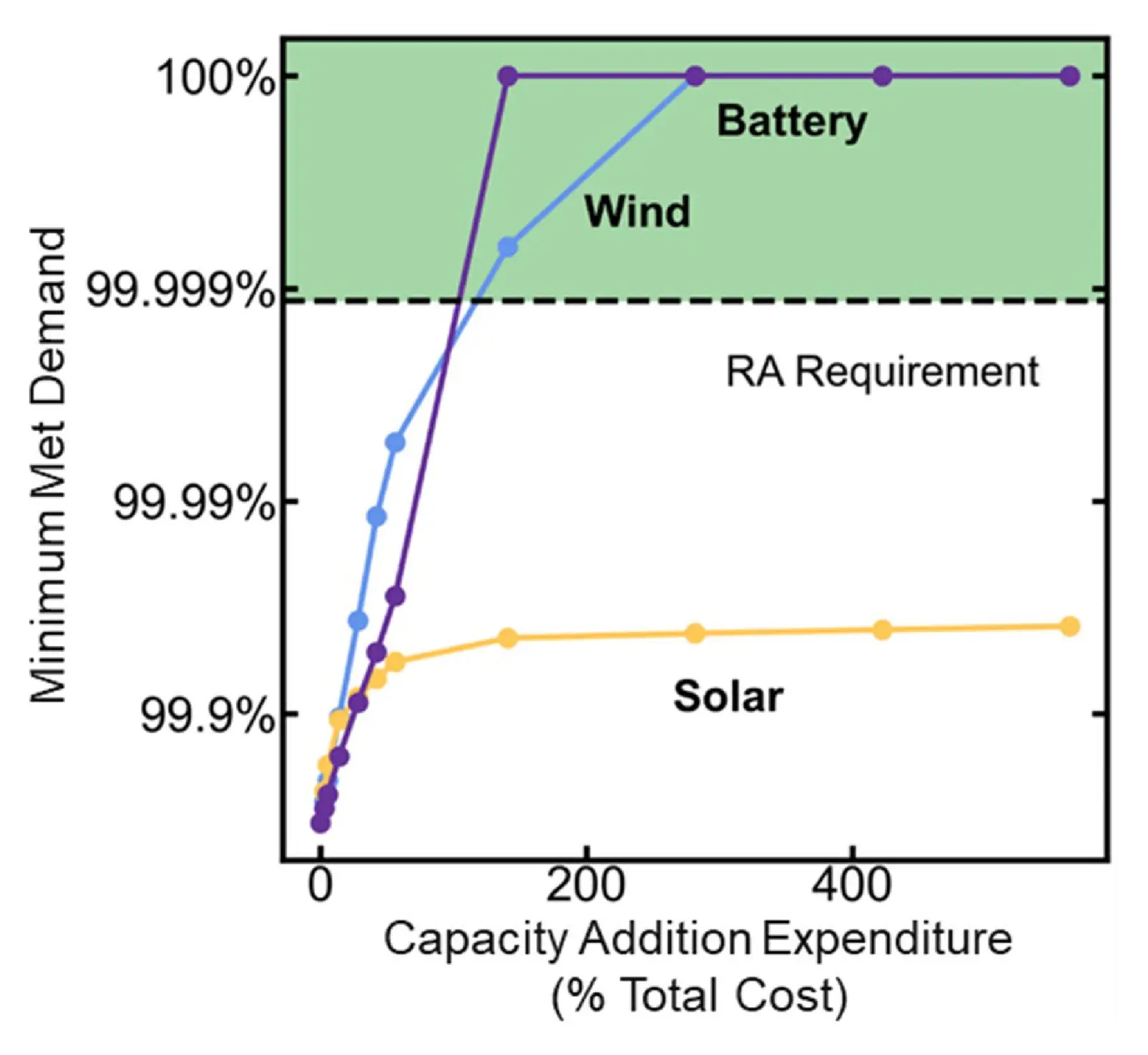
Key finding. In a stylized model of a wind, solar, and battery electricity system for the contiguous United States, planned on one year of weather and run across the 42 years 1979–2020, extra capacity costing 56% of the mean cost of electricity, split evenly between solar generation and batteries, met all demand in every system studied, while the same spending on batteries alone or solar alone left the worst system meeting only 99.97% or 99.72% of demand. For wind- and solar-based systems planned on a single weather year, added wind generation alone could reach a 99.9989% resource-adequacy target, but added solar generation alone could not, even at a cost of more than 5.6 times the mean cost of electricity.
What question did this research address?
Capacity expansion models pick generation and storage by optimizing against a limited number of historical weather years. The system they design then has to operate for decades, through weather the optimization never saw.
That leaves a gap between the capacity a short optimization specifies and the capacity long-run reliability actually requires. This paper asked how large the gap is, and — given a budget to close it — what to spend it on.
What did we find?
The method uses a stylized single-node model of the contiguous United States with lossless transmission. A least-cost system is optimized on one calendar year of weather and demand, for each of the 42 years from 1979 to 2020. Each system is then operated across all 42 years with its capacities fixed, after adding capacity of one or more technologies, and judged by the share of demand it meets.
Planning on one year does not deliver long-run reliability. Run across the 42-year record, the worst of the wind, solar, and battery systems met 99.67% of demand and the worst system that also had hydrogen storage met 96.51%, against a target of 99.9989% — the study's translation of the NERC one-hour-in-a-decade loss-of-load standard.
Buying generation and storage together was the cheapest way to close the gap. With 56% of the mean cost of electricity split evenly between solar and batteries, every system met all demand; split evenly between wind and batteries, the worst system met 99.9996%. In systems with hydrogen storage, 23% spent on solar plus 5% on hydrogen fuel cells met the target at the lowest added cost of any combination studied.
Spent on one category alone, wind worked and solar did not. Added wind costing 140% of the mean cost of electricity raised the worst system to 99.9994%, and the same spending on batteries met all demand. Added solar stalled at 99.961% even beyond 560%, and in hydrogen systems at 99.97% even at 928%, because solar adds nothing in the night-time hours where adequacy fails.
Not all storage helps equally. In hydrogen systems, extra electrolyser or salt-cavern storage capacity barely moved reliability, even alongside extra generation; extra fuel-cell capacity, paired with solar, did.
The authors argue current adequacy standards need revisiting. A criterion such as NERC's one-hour-in-a-decade loss-of-load expectation is not framed around extreme events, and they suggest treating deep multi-day wind droughts the way flood planning treats a once-in-a-century flood.
Why does it matter?
It turns a known modelling limitation into a design rule. That short optimizations under-specify capacity was already understood; this says which assets to buy with a limited budget to fix it, which is the question a planner actually faces.
The asymmetry between wind and solar is the practical core. They are usually discussed together as variable renewables, but for closing a reliability gap they are not interchangeable — solar cannot cover the hours where adequacy fails, so it needs storage alongside it in a way wind does not.
Framing the binding case as a once-in-a-century wind drought rather than an hours-per-decade average changes what a reliability standard is even measuring, and standards written the old way may pass systems that would fail on a rare deep event.
The model is deliberately simple — one node, no transmission costs, expenditures counting only added capital — so the numbers show the relative value of each choice rather than a cost estimate for a real grid.
Citation
Natasha D. Reich, Tyler H. Ruggles, Edgar Virgüez, Jacqueline A. Dowling, Ken Caldeira, and Nathan S. Lewis (2026). Cost-effective approaches to maintaining resource adequacy in wind and solar electricity systems over decades of weather variability. Environmental Research: Energy 3, 035017.
Related
- Can wind and solar power reliably meet electricity demand?
- What does a reliable electricity system built on wind and solar actually need?
- Planning reliable wind- and solar-based electricity systems (Ruggles et al., 2024)
- Identification of reliable locations for wind power generation through a global analysis of wind droughts (Antonini et al., 2024)
- Geophysical constraints on the reliability of solar and wind power worldwide (Tong et al., 2021)
- Role of long-duration energy storage in variable renewable electricity systems (Dowling et al., 2020)