Electricity systems in the limit of free solar photovoltaics and continent-scale transmission
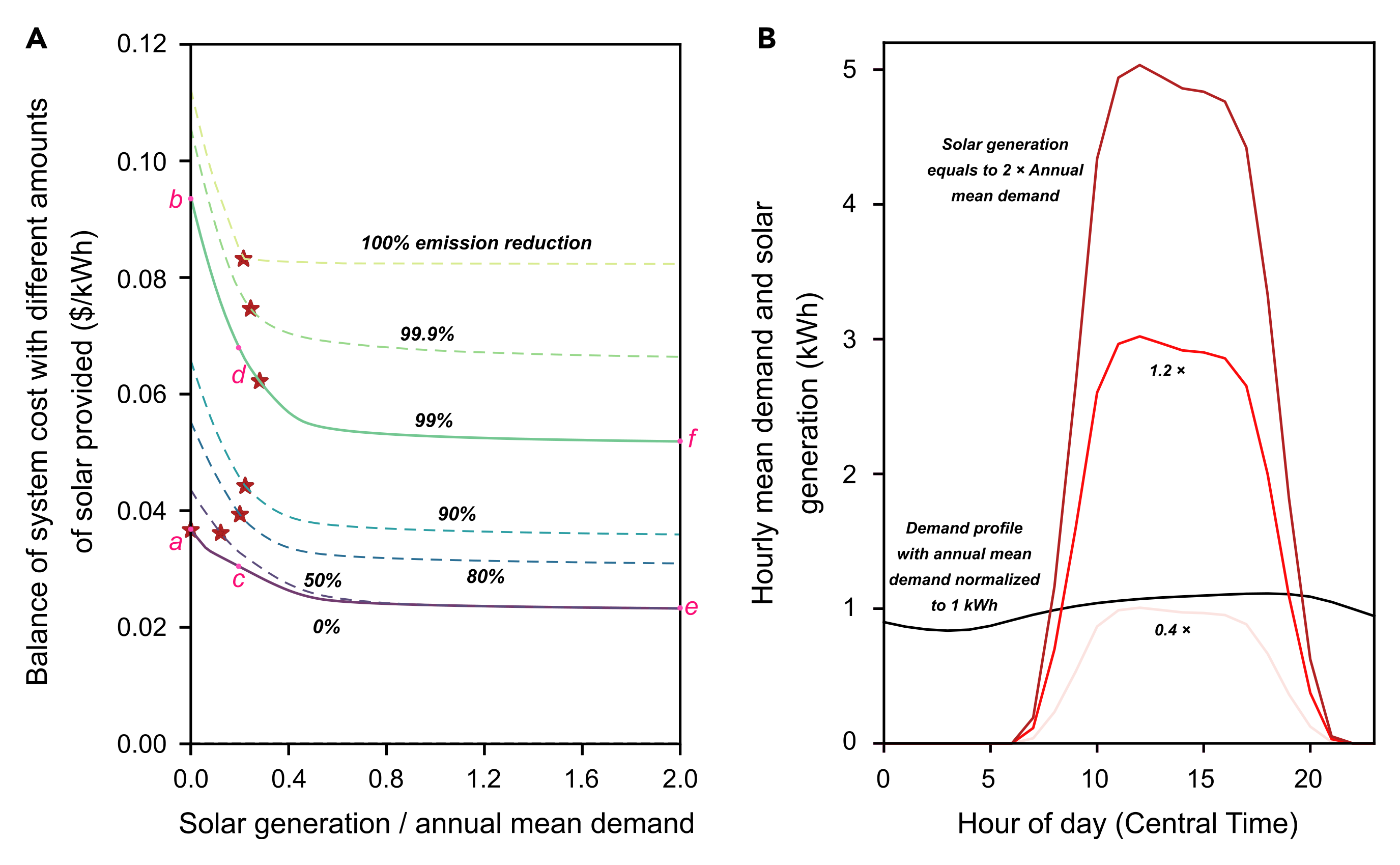
Key finding. In an idealized least-cost model of the contiguous United States with near-current technology costs and free, lossless transmission, a 99%-emission-reduction electricity system given free solar generation equal to twice annual mean demand costs $0.052 per kilowatt-hour, 41% more than an all-natural-gas system with no solar, because solar cannot meet night-time demand without costly storage.
What question did this research address?
Solar photovoltaics have become one of the cheapest sources of electricity, and some have proposed deploying them at multi-terawatt scale within a decade. A natural question is how far cheap solar alone could carry a decarbonized electricity system.
This paper took the question to its limit. It asked how much electricity would cost if we relied exclusively on solar electricity generation, assuming both solar generation and long-distance transmission were free.
What did we find?
The study used the Macro Energy Model, a linear optimization that builds capacity and dispatches it hour by hour to meet a year of contiguous-US demand at least cost. Solar capacity was prescribed, which makes it free to the optimizer; natural gas, gas with carbon capture, wind, nuclear, and battery storage then competed at the Energy Information Administration's near-current costs. Wind and solar output came from MERRA-2 weather data for the best 25% of US grid cells, pooled as if connected by free, lossless transmission.
The first solar added is very valuable. Each unit of solar initially reduces system cost more than the same amount of wind or nuclear, because solar output lines up with the daily peak in demand, and the benefit is largest under deep emission constraints, where cheap flexible gas is excluded.
That value then collapses. Because storage is expensive, the marginal value of more free solar falls to near zero once solar generation reaches about 0.8 times annual mean demand, under every emission constraint tested. Beyond that point the extra output arrives during the day, when demand is already met, and is curtailed.
Free solar does not make a clean system cheap. With free solar equal to twice annual mean demand, a nameplate capacity of 7.3 times mean demand, the system costs $0.052 per kilowatt-hour at a 99% emission reduction and $0.082 at 100%, against $0.037 for an all-gas system with no solar. The optimizer still builds wind and nuclear to supply the night, and once built they also run by day, so solar is needed for under 20% of annual demand at 99% reduction and under 5% at 100%.
Abundant solar changes what fills the night. At a 99% reduction, the system without solar is mainly nuclear; with abundant free solar it is dominated by wind.
Flexibility is what unlocks solar. With effectively unlimited free solar at a 99% reduction, battery costs would need to fall by about 40% for solar to supply more than 30% of annual demand. Shifting load in time does the same job as storage, moving demand to the day instead of moving energy to the night.
The conclusions hold under year-2050 cost projections from the National Renewable Energy Laboratory, which cut wind and storage costs by 32% and 31%, with ERA5 rather than MERRA-2 weather data, and with solar and wind averaged over all US grid cells. If the ratio of storage cost to wind cost fell by a factor of three, storage rather than wind would meet night-time demand.
The framework is deliberately idealized. It assumes no existing infrastructure, perfect foresight, hourly time steps, free transmission, and constant costs, and the authors claim robustness for the qualitative behaviour rather than the particular numbers.
Why does it matter?
It separates the cost of generating electricity from the cost of supplying it when it is needed. Even if solar panels cost nothing, a zero-emission system still has to pay for whatever powers the night, and at present costs that is the larger bill.
It explains why cheap solar has diminishing returns. The decline in solar's value at high penetration is a matter of timing, not of the price of panels, so further reductions in the cost of solar alone do little once daytime demand is covered.
It points research and policy at storage and load flexibility. Making abundant solar useful depends on low-cost ways to move energy to the night or demand to the day, and without them a deeply decarbonized system leans on wind and nuclear for the hours solar cannot serve.
Citation
Lei Duan, Tyler H. Ruggles, and Ken Caldeira (2022). Electricity systems in the limit of free solar photovoltaics and continent-scale transmission. iScience 25, 104108.
Related
- What does a reliable electricity system built on wind and solar actually need?
- Effects of deep reductions in energy storage costs on highly reliable wind and solar electricity systems (Tong et al., 2020)
- Role of long-duration energy storage in variable renewable electricity systems (Dowling et al., 2020)
- Stylized least-cost analysis of flexible nuclear power in deeply decarbonized electricity systems considering wind and solar resources worldwide (Duan et al., 2022)
- Implications of uncertainty in technology cost projections for least-cost decarbonized electricity systems (Duan and Caldeira, 2024)