Opportunities for flexible electricity loads such as hydrogen production from curtailed generation
Key finding. Least-cost US electricity systems built at current costs to meet existing demand could supply about 25% more electricity to a flexible load, such as hydrogen production by electrolysis, with at most 6% more generating capacity, while lowering the average cost of delivered electricity by 13–20%.
What question did this research address?
Electricity systems are built to meet demand in its highest hours, and systems with a lot of wind and solar power also discard, or curtail, output that arrives when it is not needed. That spare capacity has prompted interest in flexible uses for cheap, low-carbon electricity, of which producing hydrogen by electrolysis is the most discussed.
This paper asked how much flexible load could be added to such systems before new generating capacity is needed, how the cost of electricity divides between the existing firm load and the new flexible load as the flexible load grows, and what that implies for the cost of hydrogen.
What did we find?
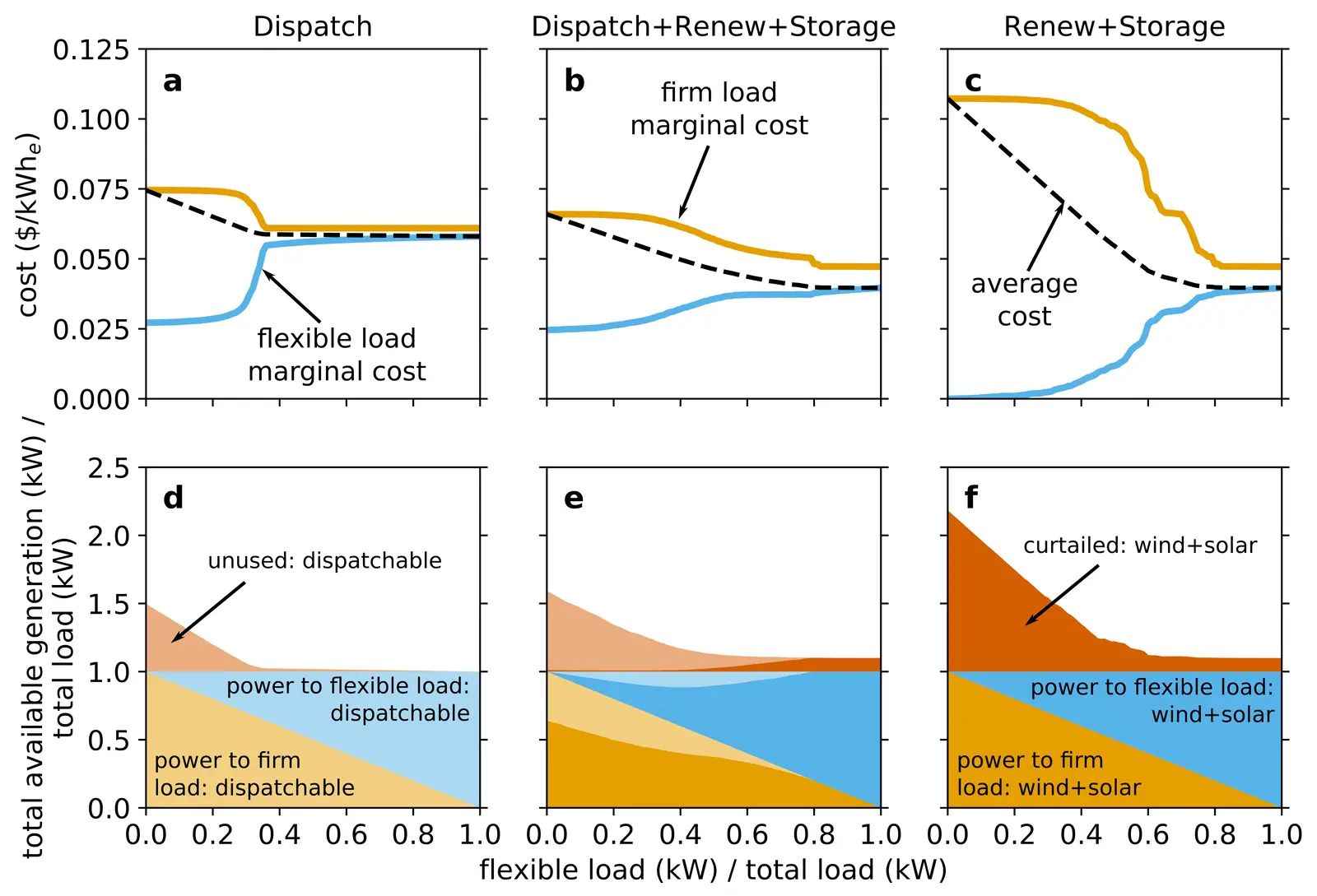
The study used a least-cost model of the contiguous United States, with 2017 hourly demand, wind and solar output from MERRA-2 weather data for the best 25% of US grid cells, lossless transmission, and 2019 technology costs. Three scenarios were run — natural gas with carbon capture alone; that plus wind, solar, and batteries; and wind, solar, and batteries alone - each with the flexible share of total load stepped from 0 to 100%.
Systems built only for firm demand have a great deal of spare capacity. With no flexible load, 33% of the electricity the system could have generated went unused in the gas-only scenario and 54% in the wind, solar, and battery scenario. In the gas-only case, unused capacity was available in 99.7% of hours.
Up to a flexible share of about 20% of total load, the flexible load runs on capacity built for the firm load. Generating capacity grew by less than 0.1% in the gas-only and wind-solar-battery scenarios and by 6% in the mixed one, the electrolyzer ran at more than 90% capacity factor, and the average cost of delivered electricity fell by 13% in the two scenarios with gas and by 20% with wind, solar, and batteries alone.
At that stage the flexible load pays only the running cost of the generator that would otherwise sit idle — about $0.027 per kilowatt-hour for gas fuel, and nothing for wind and solar output that would otherwise be curtailed. Beyond about 20%, new capacity has to be built for the flexible load, the electrolyzer's capacity factor falls, and the marginal costs paid by the flexible and firm loads converge as they share the cost of capacity.
Priced at the marginal cost of electricity, hydrogen cost less than $2.70 per kilogram in every scenario when the flexible load was small, and less than the US Department of Energy's $2 per kilogram goal in the wind, solar, and battery scenario until the flexible load reached about half of the total. The authors note that real electricity customers do not in general pay real-time marginal prices.
Flexibility elsewhere in the system competes for the same spare output. Where natural gas could follow the load, only 2% of the unused generation was free wind and solar, so even the first hydrogen paid for gas fuel; adding power-to-gas-to-power storage to the wind and solar system cut curtailment by about 60% and left less for the flexible load.
The model is idealized, with perfect foresight, a single weather year, free transmission across the country, and no subsidies. The authors argue that most of these simplifications understate the spare capacity a real system would have, and that their conclusions did not change substantially under lower technology costs.
Why does it matter?
It identifies a cheap starting point for hydrogen and other flexible industries. Capacity that a grid already needs for its peak hours can supply a substantial new flexible load almost free of capital cost, and the existing customers benefit too, since the same assets serve more electricity.
It also marks where that opportunity ends. Once flexible loads grow past roughly a fifth of total demand, they must start paying for new generation, so a large hydrogen economy cannot be built on surplus electricity alone.
It shows that the opportunity depends on the rest of the system being inflexible. Batteries, long-duration storage, dispatchable generation, and demand response all reduce the surplus a flexible load can draw on, and different flexible loads — hydrogen, electric vehicles, heating — will compete for the share that remains.
Citation
Tyler H. Ruggles, Jacqueline A. Dowling, Nathan S. Lewis, and Ken Caldeira (2021). Opportunities for flexible electricity loads such as hydrogen production from curtailed generation. Advances in Applied Energy 3, 100051.
What we are thinking
- Hydrogen production from curtailed generation (by Ken Caldeira, 7 July 2021)
Related
- What does a reliable electricity system built on wind and solar actually need?
- Utilizing curtailed wind and solar power to scale up electrolytic hydrogen production in Europe (Ganter et al., 2025)
- Role of long-duration energy storage in variable renewable electricity systems (Dowling et al., 2020)
- Global land and water limits to electrolytic hydrogen production using wind and solar resources (Tonelli et al., 2023)
- Opportunities and constraints of hydrogen energy storage systems (Dowling et al., 2024)